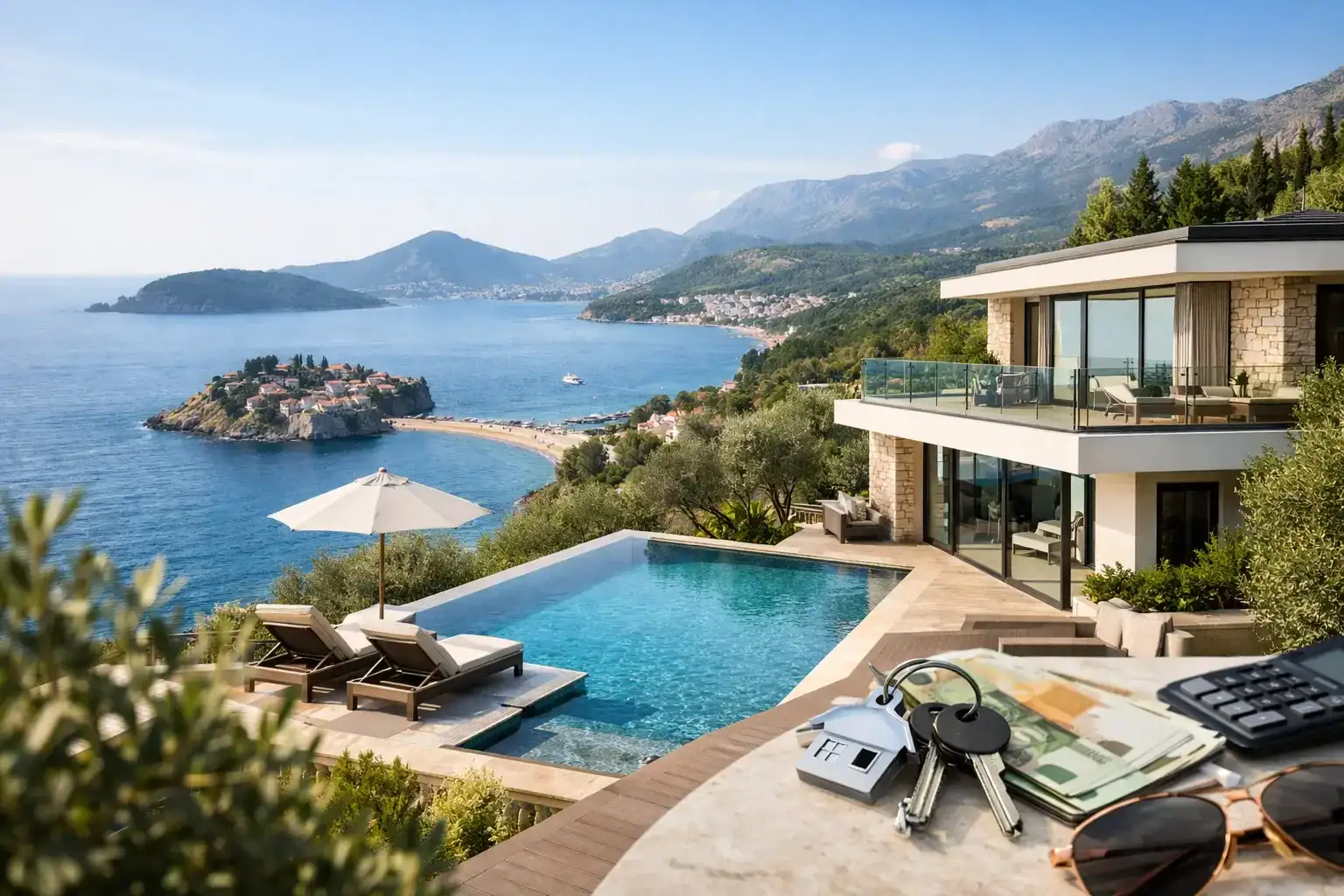



Buying a villa is rarely an impulsive decision. Most often, it starts with an image – a sea view, privacy, a pool, a landscaped garden – but it ends with documentation, valuation, and a series of questions that must be answered clearly. That is precisely why the question of how to buy a villa without risk is not a matter of habitual caution, but a way to preserve capital and make a decision that has long-term value.
In the premium real estate segment, mistakes are usually more costly than in the standard housing segment. It's not just about the price per square meter, but about what that price actually includes: legal status, construction quality, access to the plot, potential for future resale, and realistic investment potential. A villa can look exceptional in photos, yet in practice, carry a series of limitations that the buyer only discovers when it's too late to back out.
How to buy a villa without risk in practice
The first step is not viewing properties, but defining criteria that make financial sense. Buyers often say they are looking for a villa in a good location, but this is too broad a term to lead to a secure purchase. It is much more useful to determine whether a private residence, a seasonal home, or a rental investment is your priority, as each of these purposes changes the evaluation criteria.
If you are buying for personal use, peace, access, and the quality of the environment carry more weight. If you are buying as an investment, occupancy, micro-location attractiveness, and demand sustainability become more important. The same villa can be an excellent choice for living, but an average choice for investing. Risk often arises precisely when these two goals are mixed.
Therefore, serious buying begins with the question: what do you need that property to do for you over the next five to ten years? When the answer is clear, it is easier to reject offers that appear impressive but do not meet essential requirements.
Location isn't just prestige
In the luxury segment, location carries symbolic and market value, but not every prestigious address is automatically a safe purchase. It's necessary to look beyond the name of the place itself. Access roads, proximity to amenities, level of privacy, the urban environment, and the development potential of the immediate area are important.
A villa with an open view can be an exceptional opportunity today, but if urban planning conditions allow for intensive construction on adjacent plots, that view may not be protected long-term. Similarly, a property in a quiet area can be ideal for family use, while that same isolation can reduce its attractiveness for short-term rentals.
A serious buyer therefore evaluates not only the address, but also the future of the location. This is one of the key differences between an emotional and a thoughtful purchase.
What should be checked around the location itself
It's worth paying attention to the infrastructure, year-round access, utility services, and planned development in the surrounding area. Especially with villas on the coast or on elevated ground, practical details often determine the quality of life more than aesthetics itself. A view sells a property, but access, parking, and functionality make it a sustainable purchase.
The legal status must be completely clear
The biggest risk when buying a villa is not always visible on the ground. It is often hidden in the property deed, the basis of acquisition, encumbrances, or discrepancies between the actual and registered condition. A property can be luxuriously furnished and architecturally impressive, yet lack proper documentation that allows for a secure purchase.
The buyer must know who is registered as the owner, whether there are any encumbrances or restrictions, whether the property and its areas are recorded in accordance with the actual state, and whether additions, pools, outbuildings, or terraces are legally covered. For villas, this is particularly important, as it is precisely the additional features that significantly affect the value of the property.
If what you are buying is not legally sound, you are not buying security, but an expensive problem. That is why a professional legal review is a mandatory phase, not a formality before signing the contract.
Special caution with new construction and renovations
For new villas or significantly renovated properties, it is important to check the construction and usage documentation, the compliance of the as-built condition with the project, and the status of all auxiliary units. On paper, minor deviations sometimes seem harmless, but they can become serious obstacles in later sales or financing.
Real value is not the same as asking price
On the premium market, the difference between the asking price and the real value can be significant. Owners often build an emotional valuation, renovation costs, or the expectation that exclusivity itself justifies any price into the asking price. However, the market does not reward every owner's investment to the same extent.
That's why it's important to analyze more than just aesthetics. You should consider the relationship between price and micro-location, construction quality, plot position, building age, equipment level, energy efficiency, and the property's liquidity if you plan to sell it later. A villa that appears more expensive than its competitors might be for a reason, but that reason must be measurable.
A smart buyer not only asks how much a villa costs, but why it costs that much. If the answer is not convincing, there is likely room for negotiation.
Negotiating when buying a villa requires strategy
When it comes to luxury real estate, negotiations aren't just about lowering the price. Sometimes, negotiating payment terms, included furnishings, handover procedures, repairs for discovered defects, or the seller's move-out timeline is more important. Well-managed negotiations reduce risk just as effectively as a good contract.
A mistake buyers often make is showing too much interest too soon. When a seller assesses that you are emotionally attached to a specific villa, its flaws lose weight, and your negotiating position weakens. It is much more effective to conduct the conversation based on facts—documentation, market comparisons, and the property's technical condition.
This is precisely where an agent's experience makes a difference. In a market where prices are often subject to individual appraisal, negotiations without local insight can easily lead to overpaying or missing a good opportunity.
Technical inspection saves more than it costs
Luxury finishes can hide expensive problems. Dampness, poor waterproofing, inadequate carpentry, installation issues, pool equipment, or retaining walls are not always visible on the first walkthrough. For villas, especially those in attractive locations or near the sea, a technical inspection is not an exaggeration but a reasonable investment protection.
This is particularly important when the property is older or has been renovated multiple times. An aesthetically renovated property can make a great impression, but if the underlying systems are not reliable, future costs can significantly alter the overall purchase calculation.
A buyer planning for carefree use or renting out must know not only how much they are paying today, but also how much the villa will realistically cost to maintain tomorrow.
How to buy a villa without risk if you are buying as an investor
Investors often start with location and potential return, which is logical, but not enough. A villa as an investment must have a clearly defined target audience. Not every luxury property is equally suitable for short-term rentals, long-term leases, or later resale.
It is necessary to assess the seasonality, level of competition, expected operating costs, and demand for that type of property. A villa with spectacular character can be extremely attractive in marketing, but if it is too expensive to maintain or too specific for a wider customer base, its investment flexibility decreases.
A good investment isn't necessarily the most eye-catching villa on the market. Often, it's one whose price, location, and functionality leave enough room for both income and a secure exit strategy.
The role of a trusted partner throughout the entire process
Buying a villa risk-free rarely comes down to one piece of good advice. It's the result of a well-managed process where market appraisal, property selection, legal checks, negotiation, and transaction organization are all connected. When these phases are not aligned, the room for avoidable errors, delays, and costs increases.
That's why buyers in the premium segment most value a partner who not only offers access to properties but also the ability to filter out risk before it becomes your problem. Nekretnina.me builds its value precisely on this – on local market knowledge, a carefully selected offer, and support that gives the buyer the confidence that every decision is legally and financially sound.
In the end, a good fairy is not just one you fall in love with easily, but one you can buy with peace of mind, use with pleasure, and sell one day without unpleasant surprises. When you shop with discipline, luxury ceases to be a risk and becomes a thoughtful asset.