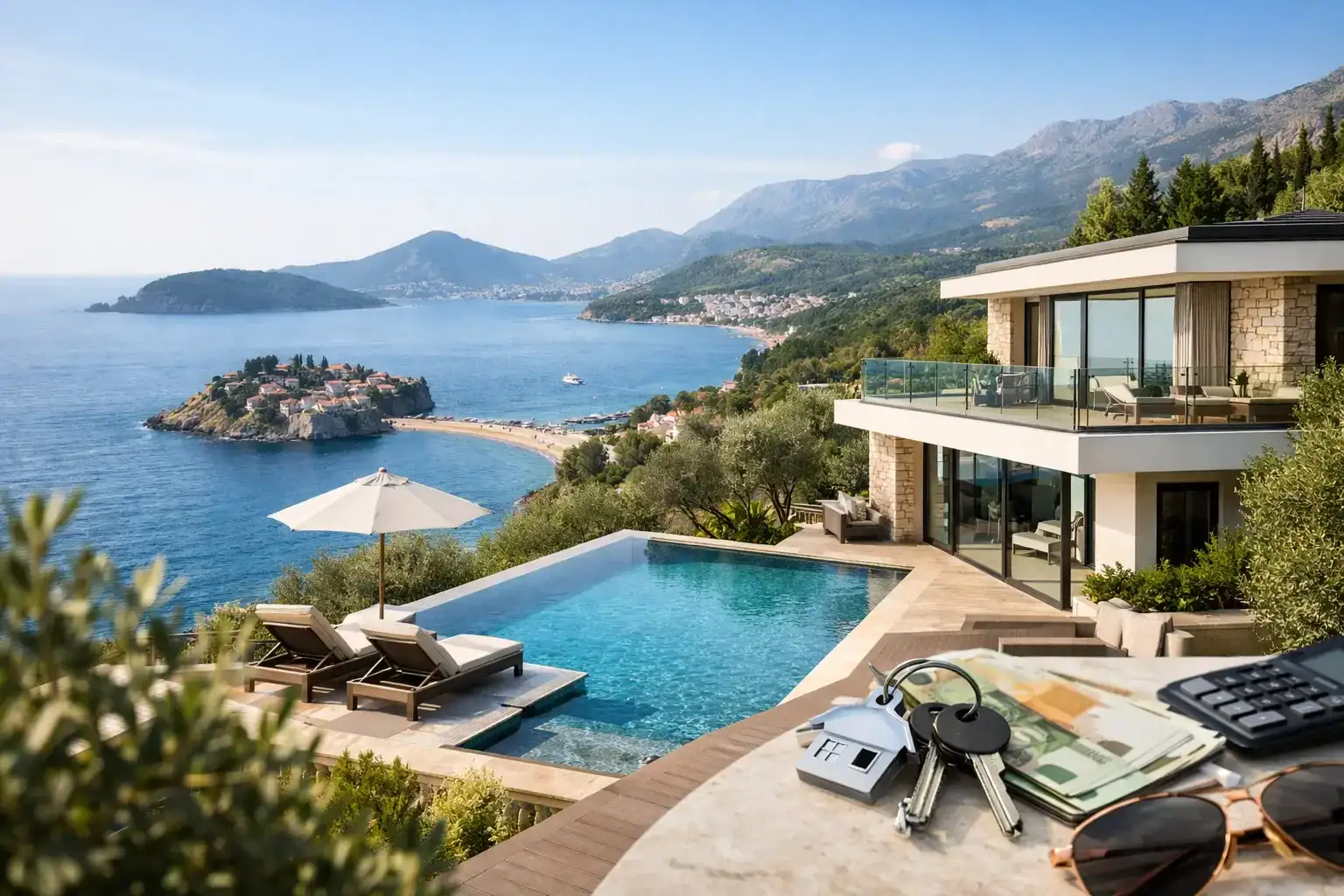



A villa may seem flawless on the first viewing: a sea view, a private pool, a carefully decorated interior, and an address that carries weight. Yet, with properties like this, the price is often not just a number in the listing. The question of how to negotiate the price of a luxury villa requires more than a boldly stated lower offer—it calls for an accurate assessment of the location, the quality of the property, legal security, and the seller's true motivation.
In luxury real estate, negotiations do not start with an offer, but with preparation. A buyer who understands what they are truly paying for negotiates more calmly, more convincingly, and with a greater chance of securing terms that match their lifestyle and investment goals.
First determine the actual, not the advertised value
The asking price is the seller's starting position. Market value is the amount an informed buyer can justify with comparable properties and the specific characteristics of the villa. The difference between those two numbers can be small in rare, impeccably maintained properties, but can be significant when the price is based primarily on the owner's ambition.
Compare the villa with similar properties in the same microlocation, of approximate surface area, construction quality, and level of privacy. A villa on the first line to the sea, a residence within a landscaped resort, or a property with direct connection and services cannot be realistically compared to a house a few minutes away from the coast. In the luxury segment, it is precisely the details that create the biggest differences in value.
Also observe how long the property has been on the market. A longer presence on the market does not automatically mean that something is wrong with the villa, but it can open room for a more serious discussion about the price. It is particularly relevant whether the price has been changed, whether the property is vacant, and whether the seller ties the purchase of another property or an investment to this sale.
Don't pay for square footage alone
The price per square meter can help as a guideline, but it is not enough for a decision. Two villas of the same size can have completely different values due to the configuration of the plot, access, quality of the view, architecture, age of the installations, and future construction potential in the surroundings.
Check whether the view is permanently protected or if there is a plot where construction is possible. Pay attention to the width of the access road, parking, boat mooring, terrace privacy, finishing quality, and the maintenance costs of the pool, elevator, smart systems, and landscaped garden. These are elements that affect both daily comfort and future resale value.
How to negotiate the price of a luxury villa without damaging the relationship
In luxury transactions, the tone of an offer is just as important as its amount. A low, unjustified offer can close doors, especially if the seller is not under time pressure or is emotionally attached to the property. The goal is not to demonstrate negotiating power at all costs, but to present the seller with a serious, credible buyer with a clear basis for the offer.
Instead of stating that the villa is „overpriced,“ it is more precise to specify what influences your assessment: the need for renovation, the cost of completing the exterior, access limitations, a lack of certain documentation, or a comparison with similar properties recently offered. Such an approach does not dispute the home's value, but rather brings the conversation back to verifiable facts.
A good first offer should be realistic, but it does not have to be your absolute limit. Leave reasonable room for the seller's response, with a pre-defined maximum beyond which you do not want to go. That maximum should not be determined solely by your budget. Factor in taxes, notary and legal fees, any commission, furnishing, renovation, and annual maintenance.
The power of the offer is not only in the amount
A seller sometimes chooses a lower offer if it brings greater certainty. A confirmed source of funds, a fast and clearly organized process, readiness for a defined contract closing deadline, and a limited number of reasonable conditions can carry significant weight.
If you depend on financing, be transparent and prepare documentation that confirms your creditworthiness. If you are buying with cash, do not use it as pressure, but as proof that you can close the transaction without unnecessary delay. With higher-value real estate, discretion, an orderly process, and reliability often decide between two similar offers.
Negotiation doesn't always have to mean a lower purchase price. If the seller is firmly defending the amount, consider the value of other concessions: the inclusion of quality furniture, pool equipment, a boat or a mooring where relevant, completion of work before handover, a more flexible move-out deadline, or covering certain costs. It is important that each item is precisely defined in the contract documentation.
Before making an offer, check what can change the price
The most expensive mistake is to negotiate based solely on aesthetics and photos. A villa can have an excellent location and a show-stopping interior, but there may be questions about the legality of an addition, the pool's registration, rights of way, or encumbrances on the property title.
Legal and technical due diligence give you a basis for negotiation, but also protect the purchase after signing. It is necessary to check ownership, encumbrances, urban planning and technical conditions when relevant, construction and occupancy documentation, the actual condition of the property, and the conformity of that condition with records. In the case of older villas, special attention is deserved by the roof, waterproofing, facade, joinery, electrical installations, sewage system, and ground stability.
On the Montenegrin coast, added value or risk can be brought by proximity to the sea, spatial protection regimes, access to public infrastructure, and seasonal traffic congestion. In prestigious projects, it is also important to understand management rules, mandatory maintenance fees, rights to use shared facilities, and restrictions on property rental.
If an inspection reveals flaws, you do not have to give up immediately. A properly estimated remediation cost can become a solid argument for a price correction or for the condition that the seller completes the work before closing the deal. The difference is that you are not negotiating on an assumption, but on a documented finding.
Recognize when a price truly deserves a premium
Not all expensive villas are overvalued. Certain properties justifiably carry a premium because they cannot be easily replicated: a rare beachfront plot, privacy in an already developed area, architecture by a recognizable author, a secure marina, complete infrastructure, or a position within a carefully managed residential complex.
In locations such as Porto Montenegro, Luštica Bay and Portonovi, the price often includes more than just the property itself. You are buying the management standard, landscaped environment, security, service, and liquidity that a certain address may have with international buyers. This does not mean that negotiations are not possible, but rather that the arguments must be more precise and expectations more realistic.
On the other hand, villa with an individual character A villa outside a large complex can offer greater privacy and freedom, but it requires a more detailed inspection of maintenance, access, and future costs. The right decision depends on whether you are looking for a family residence, a second home, rental income, or a long-term capital position.
In negotiations, have a partner who knows the local context
An experienced broker does not just serve to transmit an offer. Their role is to separate emotional impressions from market facts, assess negotiation dynamics, and preserve a professional relationship between the parties. Especially with luxury villas, where negotiations are conducted discreetly and where a single misplaced message can change the course of conversations, local market knowledge has concrete value.
A good piece of advice is also not to rush to fill the silence. After a reasoned offer, the seller should be left with space to react. Increasing the amount too quickly sends a signal that your limit is not firm, while too rigid a stance can jeopardize the opportunity for a property that truly matches your criteria.
The best-negotiated price is not necessarily the lowest. It is the price for which you know what it includes, what risks it assumes, and why the villa has a place in your lifestyle or investment plan. When due diligence is thorough, the offer is well-reasoned, and the contractual terms are clear, purchasing a luxury villa becomes a decision made with certainty, rather than just excitement.